Tri-Rail just posted the best ridership numbers in its 37-year history — and it is using that momentum to rewrite the rules of how commuter rail pays for itself in South Florida.
Record ridership is giving SFRTA the leverage it needs
The South Florida Regional Transportation Authority (SFRTA) reported that Tri-Rail carried 4,552,826 commuter rail passengers in 2025, its highest annual total ever, topping the previous record of roughly 4,465,750 set before the pandemic. Weekday ridership averaged 14,500 in the first quarter of 2026, and the World Cup handed the system its single busiest day ever: SFRTA reported that Tri-Rail recorded its highest Saturday ridership on June 27, 2026, with more than 11,000 rides on the day of the World Cup match between Portugal and Colombia in Miami. Even in the off-season, World Cup activities boosted Tri-Rail ridership at a time when rides normally dip as the system loses student commuters; Tri-Rail averaged just under 14,000 weekday rides in June. Numbers like those don't just tell a good story at a press conference — they reset the negotiating table in Tallahassee.
- Nu Stadium effect: Tri-Rail celebrated a ridership surge following the April 4, 2026 opening game for Inter Miami CF at Nu Stadium in Miami Freedom Park, with more than 1,000 fans boarding two special trains from the Miami Airport Station.
- Record Sunday: On May 17, following the Inter Miami CF match against Portland at Nu Stadium, Tri-Rail exceeded 8,600 rides, surpassing its previous record of 8,400 set during the Ultra Music Festival in 2024.
- MiamiCentral gains: Fan Festival activities helped increase ridership at MiamiCentral Station, with more than 1,200 rides on June 24 and more than 1,100 on June 27 — the two busiest days at the station since Tri-Rail began service there in January 2024.
The FDOT memorandum of understanding charts a credible path to independence
In May 2026, SFRTA and the Florida Department of Transportation (FDOT) reached a landmark deal: the Florida Legislature authorized up to $60 million in state funding to pull Tri-Rail back from the fiscal edge, as part of an agreement in which both parties agreed that state funding would gradually decline to zero by 2037, with SFRTA retaining revenues from advertising and real estate development built around Tri-Rail stations in exchange. SFRTA's new chair moved quickly to formalize that framework. Under the proposed memorandum of understanding, FDOT's funding would gradually decline while SFRTA develops alternative revenue sources including transit-oriented development (TOD), advertising, and sponsorships — replacing what had been a 50-year dependency with a structured 10-year glide path. That is not austerity; it is a planned handoff, and SFRTA is already building the revenue base to catch itself.
- State budget: The Legislature authorized a maximum $60 million contribution following a surprise cut to $15 million for the 2025–2026 fiscal year.
- Sports cost recovery: The SFRTA board adopted a measure requiring professional sports teams to reimburse the authority for the direct cost of special game-day trains plus an additional 10% operations fee.
- TOD asset transfer: SFRTA requested that FDOT transfer station assets to the authority so it can monetize them on the road to financial independence.
Link at Boca proves the TOD revenue model is shovel-ready
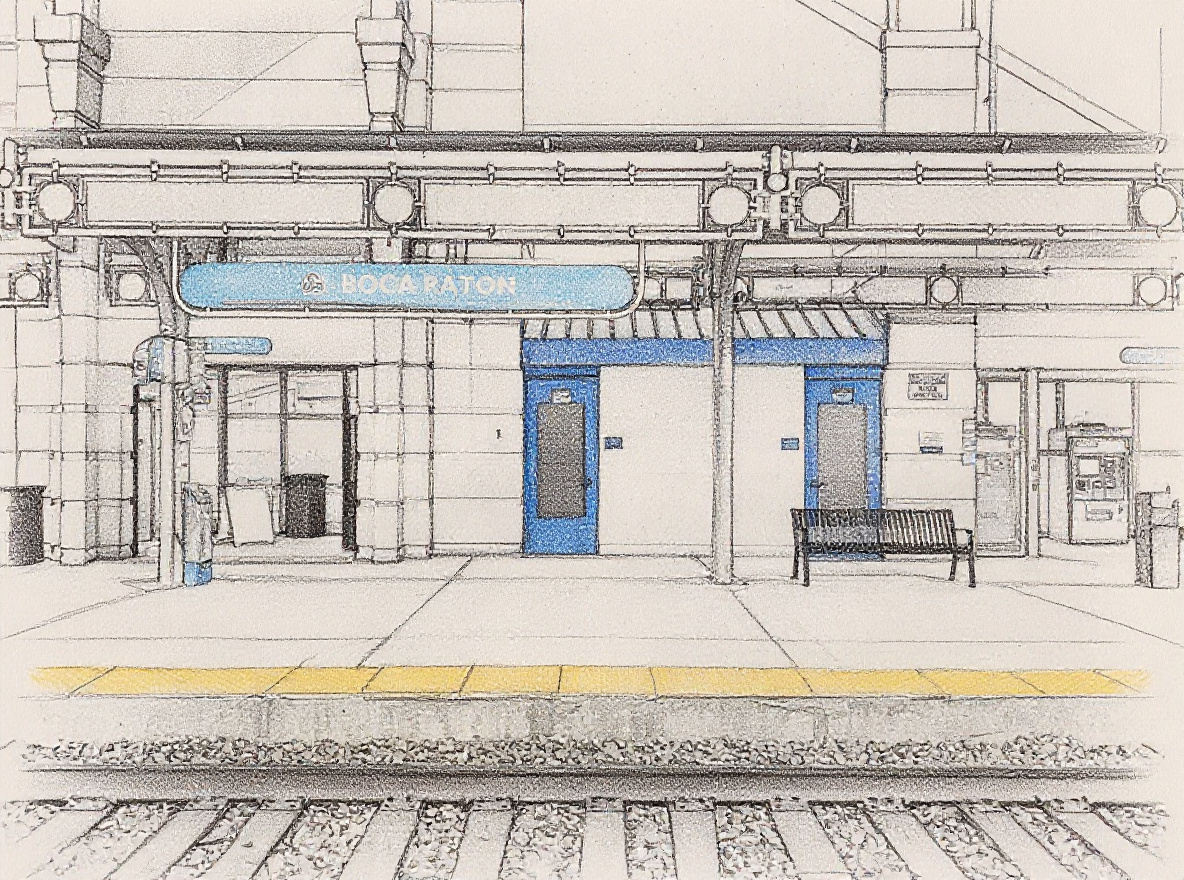
SFRTA broke ground on its first-ever TOD project in February 2026, and it makes the MOU's logic concrete. The South Florida Regional Transportation Authority began construction on Link at Boca, a transit-oriented development near Tri-Rail's Boca Raton Station that will include eight stories with 340 residential units and 24,000 square feet of retail space. Developed through a public-private partnership with 13th Floor Investments and Rockpoint, the project is strategically located off Yamato Road with direct access to I-95 and the El Rio Trail. Its proximity to Florida Atlantic University, the Boca Raton Innovation Campus, and Boca Raton Airport further strengthens the station's position as a central mobility node in the region. Link at Boca is one data point, but it is the most important kind: proof that publicly owned station land, activated through partnership, generates the recurring revenue that replaces state subsidies without raising fares or cutting service.
- Construction is expected to take approximately 24 months, bringing new housing, retail, and improved station-area infrastructure to the community.
- Northeast Corridor: The Miami-Dade County Commission approved funding for the Northeast Rapid Transit Corridor in September 2025, a 13.5-mile commuter rail route using Florida East Coast Railway tracks, connecting MiamiCentral and Aventura with five new stops in Wynwood, the Design District, Little Haiti, and at Florida International University's Biscayne Bay campus. Each new station is future TOD acreage.
The decade ahead rewards building, not waiting
Tri-Rail's ridership arc — from 3.7 million riders in 2023 to 4.5 million in 2025 — is the clearest possible argument for treating station land as infrastructure, not underutilized parking. The MOU asks SFRTA to essentially replicate, at commuter-rail scale, what Brightline already did at MiamiCentral: build enough density around the train that the train finances itself. SFRTA's chair has committed to signing the agreement with FDOT before the end of 2026, with a modeling firm already retained to stress-test the projections. The World Cup crowds, the Inter Miami matchday trains, the Link at Boca groundbreaking — all of it points in the same direction. South Florida's most established commuter rail line is in the middle of the biggest reinvention of its operating model since it opened in 1989, and if it succeeds, every subsequent station along the corridor becomes an asset rather than a liability. That is a region-wide win worth building toward.
Correction, October 11, 2026: An earlier version of this article said Tri-Rail carried 4,924,100 passengers in 2025 and averaged 13,400 weekday riders in Q1 2026. Those figures included Fort Lauderdale airport bus service, which the South Florida Regional Transportation Authority (SFRTA) does not count as Tri-Rail rail ridership. SFRTA reports 4,552,826 commuter rail trips in calendar year 2025 and a weekday average of 14,500 for January–March 2026.