Hialeah's Tri-Rail and Metrorail Transfer Station has always been one of Miami-Dade County's most strategically placed transit assets — two regional rail lines in one place, hospital jobs within half a mile, and a direct Metrorail ride to Brickell in 25 minutes. What it lacked, until recently, was the housing to match. That gap is closing faster than almost anyone predicted, and a freshly closed $226.5 million refinancing is the clearest signal yet that the market agrees.
The Metro Parc Refinancing Proves That Hialeah's Transit District Has Arrived
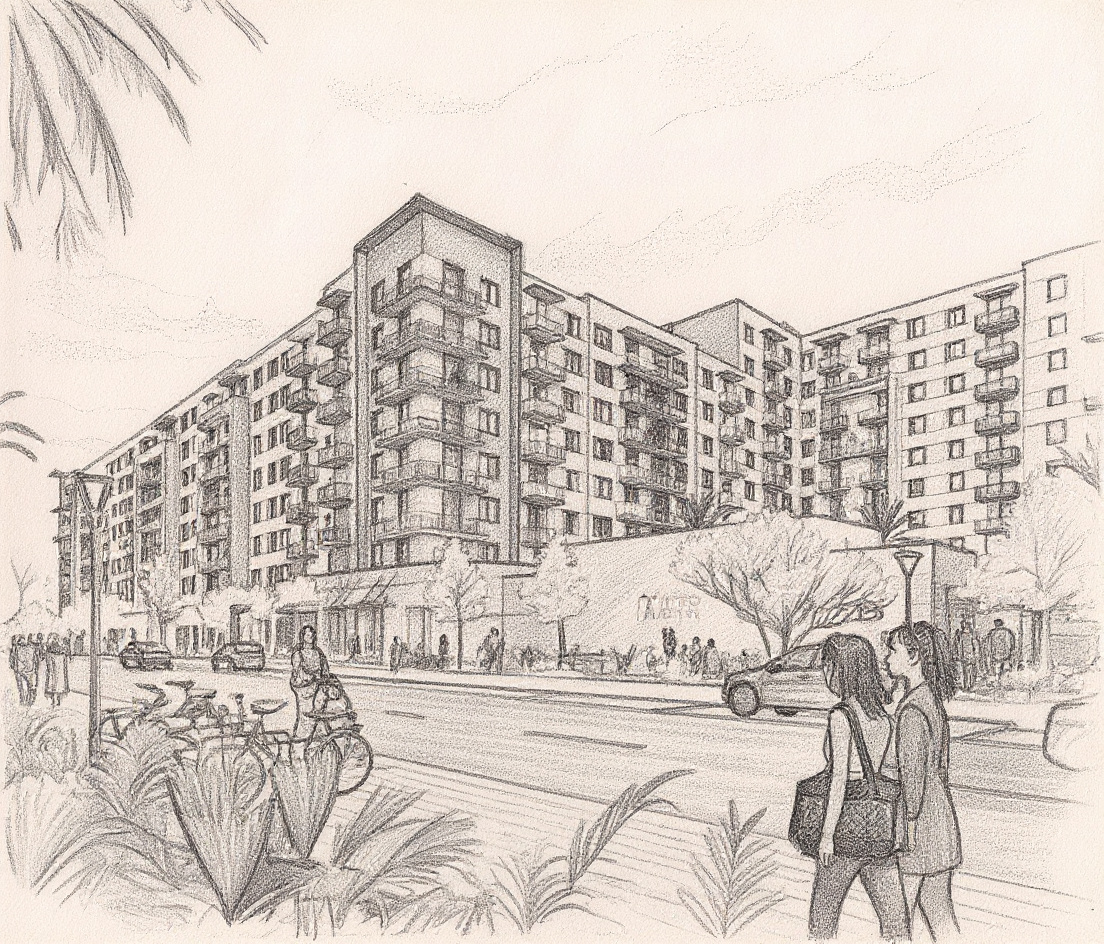
On August 14, 2026, Baron Property Group announced the closing of a $226.5 million refinancing for Metro Parc, its 559-unit mixed-use rental development at 952 East 26th Street in Hialeah — just steps from the Tri-Rail and Metrorail Transfer Station. The deal, structured by Madison Realty Capital ($125 million in senior financing) and Yellowstone Real Estate ($101.5 million in preferred equity), replaces the project's original $148 million construction loan and serves as a bridge to permanent financing while lease-up continues.
- Metro Parc reached approximately 50 percent leased as of the refinancing date, with studio, one-, and two-bedroom units in active lease-up.
- Residents can reach the Health District in 15 minutes, downtown Miami in 20 minutes, and the Brickell financial district in 25 minutes via Metrorail, according to Baron Property Group.
- The property includes more than 15,000 square feet of ground-floor retail anchored by Mr. Baker, a Cuban bakery chain with nine Miami-area locations.
A refinancing of this scale — at a 50 percent lease-up rate, no less — is institutional capital's vote of confidence that transit-proximate housing in Hialeah is a durable, not speculative, proposition.
The District's Pipeline Is Already the Size of a Small City
MG Developer and Baron Property Group are together building what they have branded the Metro Center district: a 2.3-million-square-foot, $600-million master plan of interconnected residential and retail buildings orbiting the same rail hub. The combined vision spans three major projects delivering nearly 1,600 attainable contemporary apartments within walking distance of the Metrorail and Tri-Rail Transfer Station.
- Metro Parc North (661 units, Modis Architects, KAST Construction) topped out at 955 East 26th Street by April 2026 and is targeting a late-2027 completion, backed by a $206 million construction loan.
- Metro Parc South (347 units) is planned for 954 and 934 East 25th Street and is slated for completion in 2027.
- MG Developer's boutique Metro Station 1 (55 units at 2691 East 11th Avenue) was built directly above the Tri-Rail platform, sharing a parking lot with the station itself.
- Seven buildings are either planned, under construction, or newly opened in the neighborhood, totaling over 3,000 new units across 8-to-10-story mid-rises.
Not many transit stations in South Florida — or the country — can claim 3,000 units of new housing built within a few blocks over a single decade. That is neighborhood formation, not infill.
Hialeah's Rezoning Laid the Foundation That Developers Could Build On
None of this would be possible without the deliberate zoning groundwork the City of Hialeah laid around its transit node. City leadership championed rezoning the area where Metrorail and Tri-Rail intersect, creating a transit district that permits high-density housing on blocks that had been occupied by single-family homes and light industrial uses. The city's emerging 25-year long-range growth plan — launched from its centennial year of 2025 — explicitly calls for wider sidewalks, greater housing density, and redevelopment concentrated near transit stations.
- The Tri-Rail and Metrorail Transfer Station, opened March 6, 1989, sits at East 25th Street and East 11th Avenue, and connects riders directly to Tri-Rail's full South Florida corridor.
- Hialeah is Florida's sixth-largest city, with a population exceeding 200,000 — making station-area density not a fringe amenity but a genuine citywide mobility asset.
- The South Florida Regional Transportation Authority (SFRTA) has separately marketed an adjacent site — Transit Pointe Hialeah at 2567 East 11th Avenue — for additional transit-oriented development by private partners.
The sequencing here matters: the city rezoned first, attracted developers, and private capital followed with enough conviction to refinance at scale. That is the order of operations South Florida's other emerging transit corridors should study.
What Hialeah Gains When This Goes the Distance
The Metro District is not finished building, and the real proof of concept — 3,000 apartments actively housing commuters who choose the train over the highway — is still a few years from full realization. But the trajectory is clear: a city that once seemed unlikely to anchor a transit-oriented neighborhood is now producing one of the region's most convincing examples of the form. When the full Metro Center buildout is complete, Hialeah's rail hub will be surrounded by a walkable, mixed-income, mixed-use district that gives thousands of Miami-Dade residents a genuine car-optional lifestyle. The $226.5 million refinancing is not the finish line — it is the bond market telling everyone that the race is real, the runners are serious, and Hialeah is worth betting on.