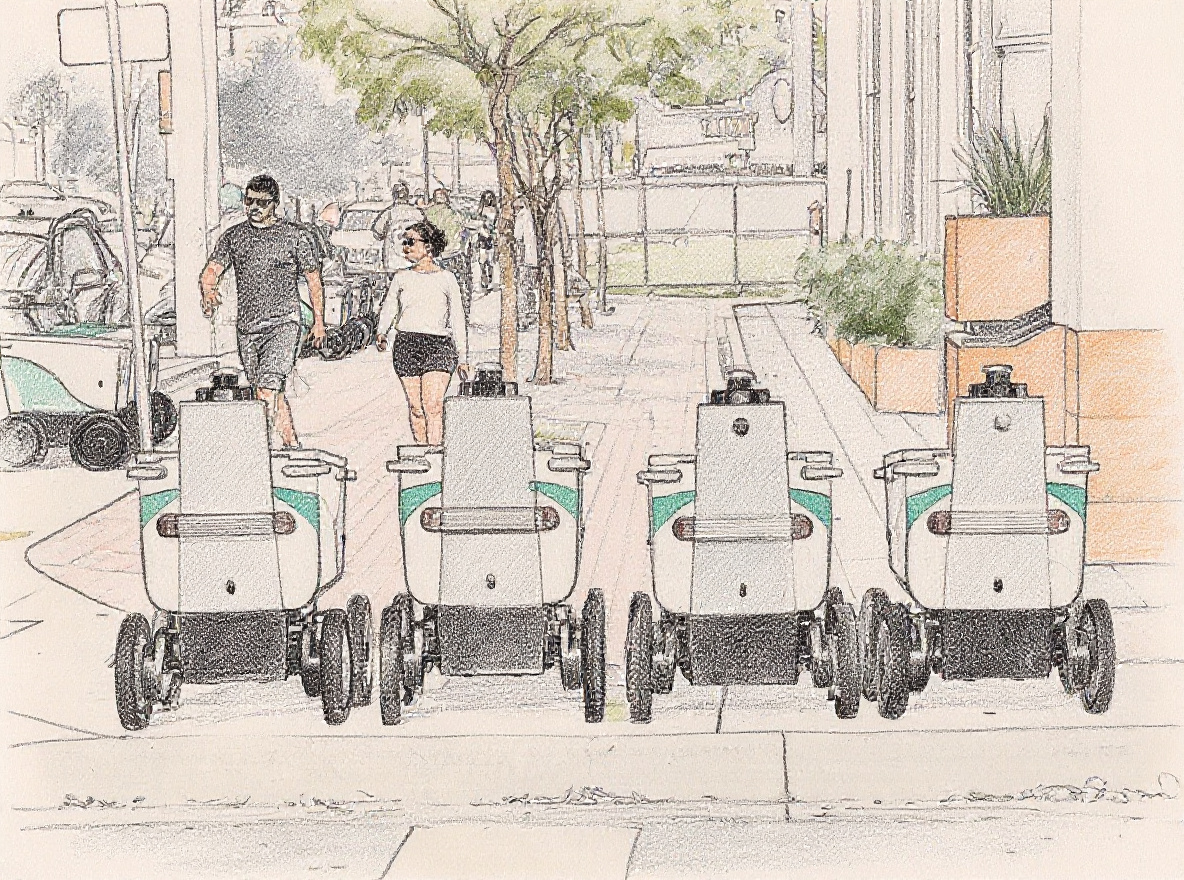
Miami-Dade County commissioners have granted preliminary approval to a detailed regulatory package governing autonomous sidewalk delivery robots, moving the county toward local oversight of a technology already multiplying across neighborhoods including Brickell, Miami Beach, Coral Gables, and Wynwood.
What did Miami-Dade commissioners actually approve?
Miami-Dade County commissioners voted to advance a local ordinance that would impose specific operational requirements on autonomous delivery robots navigating county sidewalks, layering county rules on top of existing Florida state law that already permits such devices statewide. The preliminary approval signals the commission's intent to move toward a formal vote, though the measure has not yet received final enactment.
- Florida state law currently authorizes sidewalk delivery robots to operate across all municipalities in the state.
- The proposed county ordinance would add requirements addressing robot speed limits, liability insurance, and pedestrian right-of-way protocols.
- Companies such as Serve Robotics have been deploying autonomous delivery carts across Miami-Dade's denser urban corridors.
Why is Miami-Dade acting now?
The proliferation of autonomous last-mile delivery robots across Miami-Dade's dense urban cores has created pressure on local officials to establish guardrails that Florida's statewide framework does not provide. As sidewalk robot deployments have expanded into busy pedestrian districts — from the high-rise corridors of Brickell to the arts district of Wynwood — commissioners have faced growing questions about how these devices interact with foot traffic, accessibility infrastructure, and liability in the event of an incident.
- Autonomous delivery carts have appeared across multiple distinct Miami-Dade neighborhoods, not just downtown Miami.
- Sidewalk infrastructure in South Florida's denser neighborhoods serves pedestrians, cyclists, and mobility-device users simultaneously, raising safety concerns.
- The absence of county-level speed or insurance standards had left a regulatory gap below the state level.
What does this mean for pedestrians in Brickell, Wynwood, and Miami Beach?
Residents and pedestrians in the neighborhoods where delivery robots are most active — Brickell, Wynwood, Coral Gables, and Miami Beach — stand to be most directly affected if the ordinance receives final approval, as local rules would govern how fast robots may travel, what insurance coverage operators must carry, and which users have priority on shared sidewalk space. The right-of-way provisions in particular could clarify long-ambiguous encounters between robots and pedestrians on narrow South Florida sidewalks.
- Speed limits embedded in the ordinance would constrain how quickly robots can move through pedestrian zones.
- Insurance requirements would establish a financial backstop for pedestrians injured in robot-related incidents.
- Right-of-way rules would formally define pedestrian priority relative to autonomous delivery devices.
What happens next for the Miami-Dade robot rules?
The ordinance must clear additional commission review before taking effect as binding county law. Miami-Dade's regulatory approach could also serve as a model for other Florida counties grappling with the same technology, given that state law provides authorization but no local operational framework. Stakeholders including delivery technology companies, disability-rights advocates, and neighborhood associations are likely to weigh in as the measure advances.
Original reporting on this story was published by Miami Today.